

Over the past two years, phone makers have added nearly every AI feature they could think of to their systems: photo editing, summaries, writing, call translation, and even organizing a two-hour meeting. The feature lists keep growing, but the practical change has been smaller than expected. Most of the time, AI still only answers a question. The user has to open the right app, enter the required information, and finish the job.
At the 2026 OPPO Developer Conference in Zhuhai on September 17, ColorOS 17's focus was not "more AI," but "proactive intelligence." The new Breeno can organize schedules, flag risks, plan trips, and try to use third-party services to complete tasks instead of only chatting. Three underlying capabilities support this shift: the On-Device Compute large model, the Persona X memory co-evolution engine, and the Agent Matrix agent ecosystem framework.
Together, these technologies address three questions:

Can AI reason efficiently on the phone? Can it keep understanding the same person over time? And after it figures something out, can it actually finish the job?
For phone AI, the dividing line is not whether it can talk, but whether it can finish the job
Breeno in ColorOS 17 is difficult to describe as a traditional voice assistant.
Traditional assistants rely on an ever-expanding command list. Setting an alarm, checking the weather, and turning on the flashlight all have clear entry points and results. Real-life requests are less tidy. When a conversation includes an invitation, the system first has to identify the time and place, then decide whether to create a calendar event. When a train is about to arrive, it may need to find the station and time in ticket information, then surface a pickup code or navigation at the right moment. A simple request such as "Help me arrange this" may involve several apps and services.
ColorOS 17 is designed to handle these vague but common tasks.

The new Breeno supports longer-context conversations, and users can adjust its mood, expression style, and response length. More importantly, it looks for clues in schedules, notifications, and the current situation instead of waiting for the user to start every interaction.
The new Breeno Space turns calendar events, invitations from friends, and upcoming movies or trips into separate to-do items. Important items move to the top and trigger reminders at the appropriate time. Its value is not simply creating another schedule. It makes the initial judgment that something is worth recording.
That is the difference between an agent experience and an ordinary AI feature. An agent deals with a changing goal and has to combine context, personal preferences, and the environment to make decisions. An ordinary AI feature usually completes one isolated action. Keeping this experience running on a phone requires more than connecting to a large cloud model.

Three technical foundations for a complete agent workflow
On-Device Compute: Getting the model to run on the phone first
ColorOS 17's On-Device Compute large model uses a linear-attention architecture and natively supports 128K context. According to data OPPO announced at the conference, memory use is down 48% and energy efficiency is up 55% compared with the previous generation.
The point of an on-device large model is not to copy a cloud model onto a phone unchanged. A phone has limited memory, power, and thermal headroom, while the system still has to keep foreground apps running normally. If the model has to upload every notification it interprets and every interface it analyzes to the cloud, response speed, network dependence, and exposure of personal data all become concerns. On-device computing keeps some understanding and reasoning local, giving users more control over privacy and more immediate responses. More complex tasks can still call on stronger capabilities through collaboration between the device and the cloud.
128K context deserves particular attention. On a phone, context is not limited to chat history. It may include the current screen, past schedules, recently received notifications, and the current stage of a task. Retaining this information over a longer period helps AI remember what happened in the previous step.
Persona X: Remembering you, and knowing when to forget
A model's ability to process long context does not mean it truly understands a person. Preferences are scattered across schedules, locations, contacts, images, notes, and repeated actions. Persona X, the memory co-evolution engine, combines data awareness, environmental awareness, and behavioral awareness. Through recording, forgetting, and reflection, it gradually builds an understanding of the user.
Forgetting matters as much as recording. Memory is not an unlimited database of everything on the phone. The system has to decide what is worth keeping, what is outdated, and what should only serve the current task. Organized memories can reduce follow-up questions during the next decision instead of creating more noise.

AI One-Tap Flash Note is the most direct example of this capability. The previous generation's meal-pickup-code feature has been used more than 1 billion times since launch. ColorOS 17 adds courier pickup codes and arrival reminders, contact-information storage, and concert ticket-sale reminders. The system can also recommend the next action based on the current page, connecting "save this" with "bring it back when needed."
Agent Matrix: Moving AI from understanding intent to calling services
The model handles understanding, and memory supplies personal context. What ultimately determines what an agent can do is the tools and services it can call. Agent Matrix, the agent ecosystem framework, handles this layer. It improves Breeno's understanding of context and intent, then uses device-cloud collaboration to assign tasks to different agents or third-party services.
The range of partnerships announced at the conference is specific. Users can call 200 Alipay services through Breeno, create customized travel plans with Tencent Maps, and send WeChat messages or make voice and video calls. Breeno Suggestions is connected to more than 40 major partners, with more than 150 service categories covering more than 700 specific scenarios.
Those figures matter more in practice than the number of large models connected to the system. An agent may plan the perfect sequence, but if it cannot reach payment, maps, communications, and everyday services, it still has to hand the answer back to the user. Agent Matrix is intended to cover the final stretch between intent and execution.

At the end of July this year, OPPO also launched the "Breeno Next" program for more complex, longer-running tasks. The idea is not to make one model handle everything. Instead, it assembles a temporary project team of AI specialists with different capabilities, assigns work in natural language, and advances the task in an interface similar to a group chat. Progress is reported proactively, while important deliverables stay pinned at the top.
This is not yet a universal assistant that covers every app.

The direction is clear, though: phone AI is moving beyond one round of questions and answers. It has to manage task state, coordinate different capabilities, and take responsibility for the result.
Proactive services are starting to appear in everyday details
The test of an agent is not its technical terminology. It is whether it can save the user a few taps at the right time.
For commuting, Breeno Suggestions can create travel cards based on usage habits, covering planning before departure, security-check reservations, boarding-pass display, and transit-hub reminders. OPPO's self-developed swarm sensing technology narrows location detection from broad geofences to smaller areas such as outside a station, corridors, gates, and waiting areas. OPPO gives a prediction accuracy figure of 95%; the feature currently covers subway routes in more than 30 cities nationwide.
ColorOS 17 also works with Baidu Maps and Amap to connect walking, bus, and subway segments through Fluid Cloud integrated navigation. Transfer reminders, arrival alerts, and exit directions appear as the trip progresses, so users do not have to keep switching between the lock screen, maps, and transit QR codes.
Another form of proactive assistance is error prevention. If a ride-hailing destination does not match the departure station on a ticket, Breeno can strongly remind the user to check. A food-ordering card can also make suggestions based on past tastes and habits. Proactive intelligence does not always need to complete a major task. Often, it just spots an easy-to-miss problem half a minute before the user does.
Ad content: Meydo, your pocket AI companion

Beyond agents, ColorOS 17 still puts fluid performance first
AI was the most notable change at the conference, but ColorOS 17 has not abandoned the system itself.
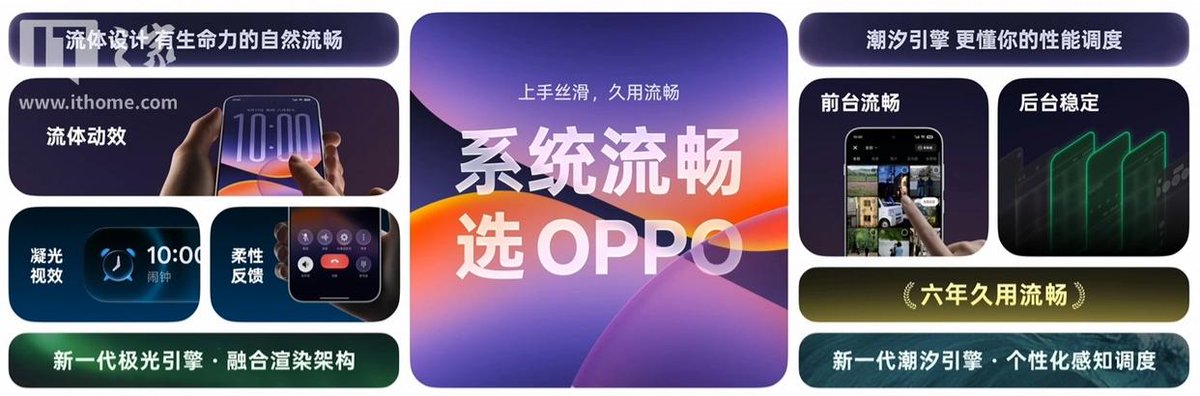
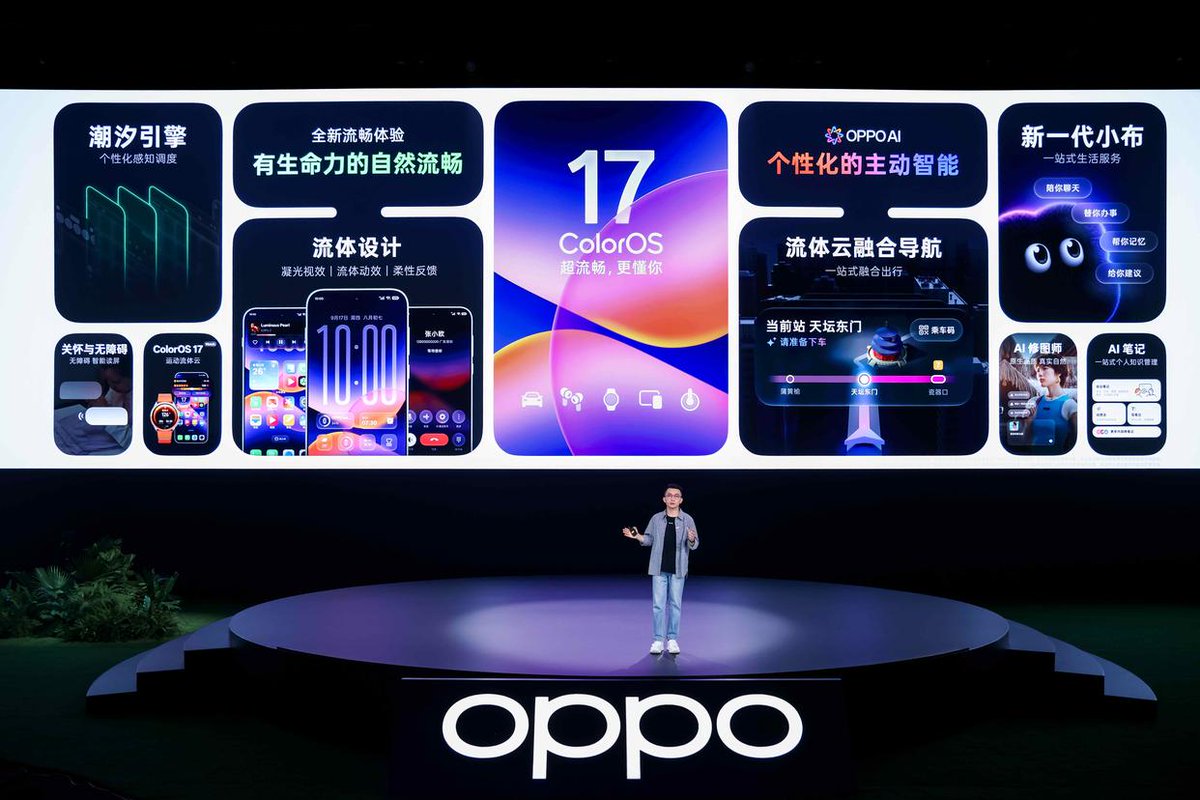
The new "Fluid Design" combines Condensed Light visual effects, fluid motion, and flexible feedback. Light is not merely decorative: the movement of light indicates playback progress, swipe paths, and page transitions. Controls contract when pressed, stretch when dragged, and bounce back when released, keeping the visual and tactile responses as consistent as possible. The Aurora Engine now reaches from the drawing layer into the rendering layer. Its fused rendering reduces load and memory use, allowing more complex animations without sacrificing smoothness.
The Tide Engine adds personalized resource scheduling. It prioritizes apps according to each person's usage patterns. The foreground app gets faster performance responses, important background apps are retained precisely, and infrequently used background apps enter cold storage. Official data says the stable retention rate for background apps in memory has increased by 55.6%. Frequent actions such as selecting photos, launching mini-programs, and jumping between pages inside apps are also faster.
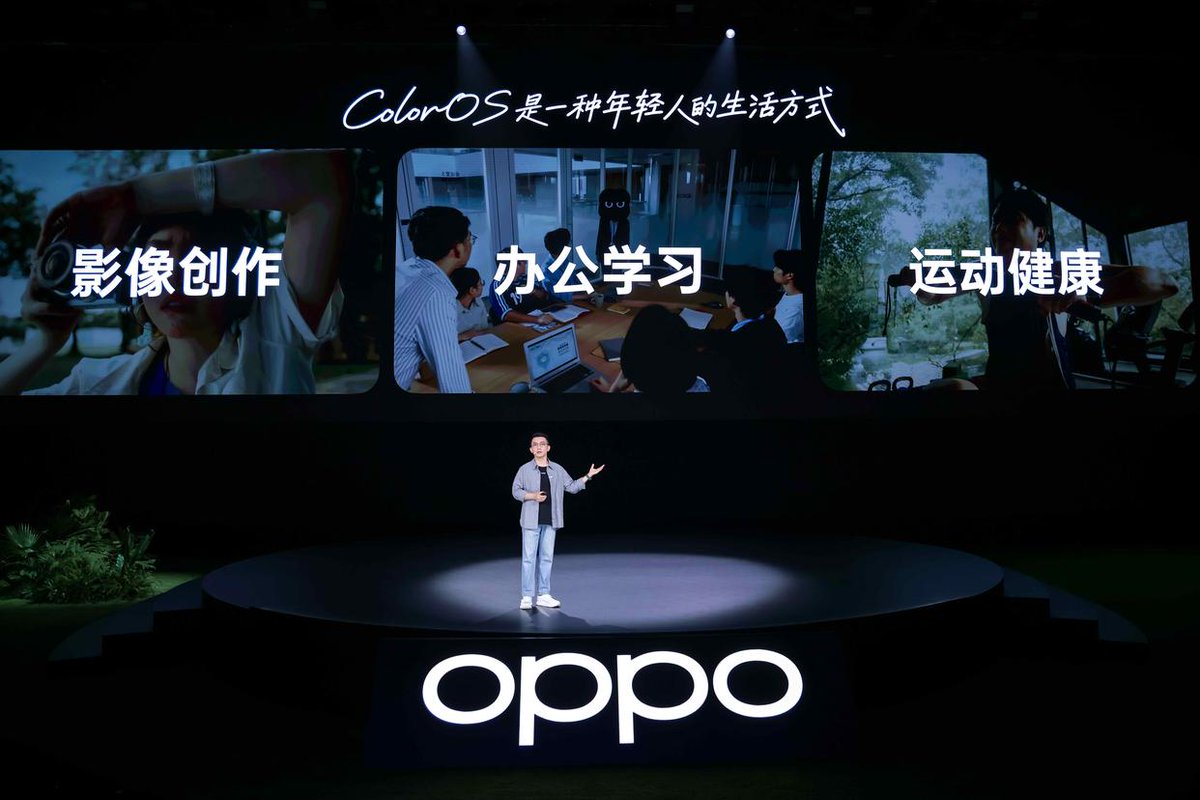
AI Photo Editor and AI Notes are two features that are easier to use immediately. The photo editor is based on OPPO's self-developed Da Vinci visual-understanding large model. Six specialist models analyze image quality, portraits, and lighting, allowing users to make adjustments such as fill light, composition, and ultra-high definition with natural-language instructions. AI Notes brings writing, recordings, scans, video links, files, and Breeno memories into one knowledge space and can generate editable information-at-a-glance graphics. As notes accumulate, the system can also extract "flash moments" and bring back information that was recorded and later forgotten.
The real test is whether users trust it with their tasks
From the feature list, ColorOS 17 has assembled the basic chain for proactive intelligence: the on-device model understands what is happening, Persona X supplies long-term memory, and Agent Matrix connects to external services such as Alipay, WeChat, and maps. Breeno Space manages information, Breeno Suggestions provides reminders, One-Tap Flash Note collects information, and Breeno Next points toward more complex multi-agent collaboration.
But the risks increase when a system moves from "giving suggestions" to "handling things for you." Which information AI has read, which service it has called, when it must ask for confirmation, and how a failed task can be undone all matter more than generating a paragraph of text. Whether third-party services remain stable, whether app redesigns break workflows, and how often multi-step tasks succeed will also require mass-market releases and long-term use to answer.
OPPO has also included an accessible intelligent screen reader, Care Mode, and end-to-end AI scam protection in ColorOS 17. The screen reader can understand unlabeled icons and buttons and announce them aloud. Care Mode enlarges text and strengthens audio and haptic feedback, while blocking high-risk software installations and sensitive permissions. End-to-end AI scam protection combines call-risk identification, synthetic-face detection, and personalized behavioral modeling to provide system-level protection for older users. These features point to a basic requirement: proactive intelligence must be capable, but it must also know which actions it should not take on its own.
ColorOS now has more than 7.7 billion monthly active users worldwide. ColorOS 17 will debut on the OPPO Find X10 series, OnePlus 16, and OPPO Watch S2. OPPO, OnePlus, and realme will also receive the first synchronized upgrade. With that many users, the rollout will become a large-scale test of whether proactive AI can work in practice.
In the past, phone AI most often answered the question, "What do you want to know?" With ColorOS 17, OPPO wants to replace it with, "Do you want me to finish this for you?" How far that path goes will depend less on the technical terms used at the conference than on whether each proactive reminder is accurate, each delegated task has clear boundaries, and each handoff produces a reliable result.
Data and image sources: Public information from the OPPO ColorOS 17 launch event, Pacific Technology, IT Home, Jinan Times, and Gfan. Product capabilities, partner services, and upgrade arrangements are subject to the official release and subsequent announcements from OPPO.
References
- Pacific Technology: Fluid and more in tune with you: ColorOS 17 officially launches, debuting on the OPPO Find X10 series
- IT Home: OPPO ColorOS 17 launches with new Fluid Design and next-generation Breeno
- Jinan Times: OPPO launches ColorOS 17, advancing proactive AI through on-device models and service partnerships
- Gfan: OPPO ColorOS 17 announces new Fluid Design, launching September 17


